


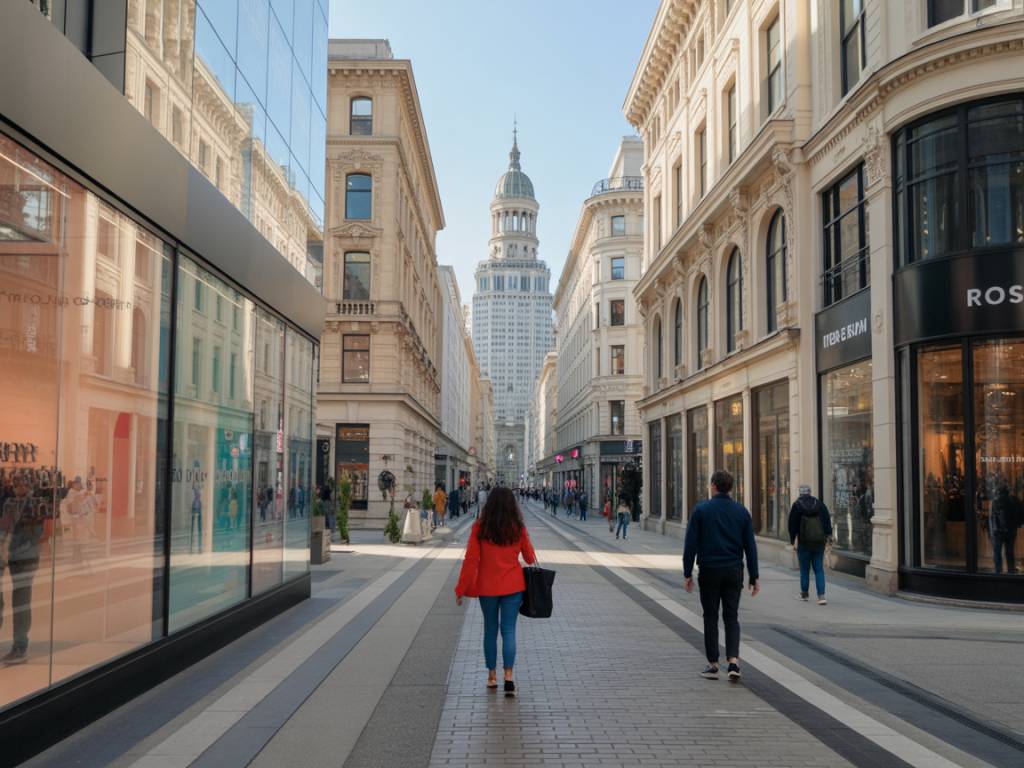
The retail game has changed. Your customer doesn’t think in terms of “online” or “offline” anymore. They just want to get what they want, when they want, the way they want.
The problem? Most retailers still operate as if website, store, app and social media were four different worlds. Internally, maybe. For your customer, definitely not.
Retail’s future belongs to those who blend in-store and digital into one seamless experience. Not “phygital” for the buzzword. But integrated because it sells more, retains better, and uses your assets (stores, data, people) much more efficiently.
Why the old split “e-commerce vs store” is killing your growth
Retailers love silos:
- Online team vs store team
- Separate P&L, separate KPIs, separate tools
- Competing for budget and credit on sales
The result is predictable:
- Customers research online, go to the store, and are told “that’s an online price, we can’t match it”.
- Store staff doesn’t know what’s in the online catalogue or current digital promos.
- Click & collect is slow, poorly integrated or treated as a burden, not a sales opportunity.
McKinsey estimates that over 60% of retail purchases are now influenced by digital in some way, even if the final transaction happens in-store. Yet many retailers still track channels separately and optimise locally instead of globally.
That’s like managing a football team by optimising every player individually without looking at how they play together.
The blended approach starts with one simple idea: stop thinking “channels”, start thinking “journey”.
Modern shoppers want four things (regardless of channel)
Your customers are not asking for magic. They want four basic things, consistently, whether they are on their phone, your website, in your store, or talking to your call centre:
- Clarity – clear information, clear prices, clear availability.
- Control – choose how to buy, how to receive, and how to return.
- Speed – no friction, no unnecessary waiting, no repeated data entry.
- Relevance – offers, recommendations and content that actually fit their situation.
In practice, this turns into expectations like:
- Check store stock in real time on their phone before going.
- Watch a product video online, then see and touch it in-store.
- Start a cart on mobile, complete it at the store (or the opposite).
- Get notified when an out-of-stock product is back in a nearby store.
- Return in-store what they bought online, without drama.
If your current setup makes any of this hard, you’re bleeding revenue and loyalty to retailers that make it easy.
From multichannel to truly blended: what changes concretely
Most retailers are already “multichannel”: they have a website, social media, maybe an app and obviously stores. That’s not the issue. The shift is from co-existence to integration.
Here’s what a blended setup changes, concretely:
- One view of stock – your online and in-store inventory are connected. Customers (and staff) see what’s available where, in real time.
- One view of the customer – same profile and history across channels. Purchases, returns, preferences and interactions are unified.
- Flexible fulfilment – click & collect, ship-from-store, reserve & try in-store, home delivery, lockers… not as side-projects, but standard options.
- Aligned incentives – you stop pitting channels against each other and reward collaboration on the total customer lifetime value.
Notice what’s not on that list: fancy in-store gadgets that impress your CEO but confuse your customer. Big touchscreens that nobody uses won’t save a broken process.
Blending is 80% plumbing and incentives, 20% “wow” effects.
In-store as a digital powerhouse, not a museum
Your store is not just a place with shelves. Done right, it becomes:
- a local logistics hub,
- a showroom,
- a service centre,
- a data collection point.
Let’s break that down with concrete applications.
1. Ship-from-store to speed up delivery
Why ship from a warehouse 300 km away if the product is already on the shelf 5 km from the customer?
Some fashion and electronics retailers now use stores as mini-warehouses. The impact:
- Faster delivery for customers.
- Better stock rotation and fewer markdowns.
- Higher store productivity (staff prepares orders between peak hours).
It does require better inventory accuracy and clear processes. If your stock is off by 15% in stores, start there before promising 2-hour delivery.
2. Click & collect that actually sells
Click & collect (BOPIS) is often treated as a cost centre: “we have to do it”. Done properly, it’s a margin engine.
Retailers that execute well typically see:
- Higher average basket size when the customer comes to pick up.
- Lower logistics cost vs home delivery.
- More opportunities to cross-sell and book services.
But only if:
- The pickup process is fast (under 3–5 minutes).
- Staff is trained to propose relevant add-ons, not just hand over a parcel.
- Your layout naturally guides click & collect customers through key zones.
3. Assisted selling with digital tools
Equip your sales associates with the same (or better) information as your website:
- Real-time stock by store and warehouse.
- Full catalogue, including sizes/colours not present in-store.
- Access to the customer’s history and preferences (with consent).
That allows simple but powerful moves like:
- Ordering a missing size on the spot for home delivery.
- Checking complementary products and suggesting them contextually.
- Creating or updating wishlists during the conversation.
One mid-sized furniture chain I worked with increased store conversion by 9% just by giving tablets to staff and training them to use them in each interaction. No redesign, no new loyalty programme. Pure enablement.
Making digital more “human” by leveraging your stores
Blending is not only about pushing digital into the store. It’s also about bringing the strengths of physical retail into your online experience.
Think about what stores do best:
- Reassure (you can talk to someone, touch the product).
- Demonstrate (live demos, try-ons, test zones).
- Create social proof (you see others buying, using, asking).
Now, how do you bring that online?
1. Video consultations with store staff
Luxury, beauty and electronics brands are increasingly offering 1-to-1 video advice with in-store experts. Typical format:
- Customer books a 15–30 minute slot from the website.
- Call is handled from a dedicated area in-store or from a central hub.
- Staff uses cameras and the physical inventory to show products, compare, explain.
This mixes the trust of store interactions with the convenience of staying at home. It also uses your best salespeople far beyond the four walls of their store.
2. Live shopping and in-store events streamed online
Instead of organising events just “for the store”, think hybrid:
- Product launches with a live audience in-store and online viewers.
- Workshops (cooking, DIY, beauty routines) streamed and replayed.
- Q&A sessions with experts where questions come from both in-store and digital.
This content feeds your social channels, newsletter and website for weeks, at a fraction of the cost of a classic campaign.
3. Appointment-based experiences
Let customers book time with you, online, but use the store as the stage:
- Personal shopping sessions.
- Fitting room appointments with pre-selected items.
- Technical consultations (home office, TV setup, smart home, etc.).
Confirmation, reminders and prep happen digitally. The value is captured in-store. This is especially powerful for higher-ticket purchases, where human support beats any algorithm.
Key technologies that actually matter (and those that don’t)
Retail tech is full of noise. Holograms, VR fitting rooms, robots… Great for PR, not always for ROI.
If your goal is to blend in-store and digital in a way that generates results within 12–24 months, focus on this stack first:
- Unified commerce platform – your POS, e-commerce, and order management need to talk to each other in real time. If they don’t, everything else is lipstick on a pig.
- Inventory accuracy & tracking – RFID, good processes, frequent cycle counts. If you promise “available in store” and it’s not, you destroy trust fast.
- Customer data platform (CDP) or equivalent – one place where you unify identities (email, phone, loyalty card, cookies, app ID) and behaviour across channels.
- Mobile tools for staff – tablets or smartphones with secure access to stock, customer profiles, catalogue and basic CRM features.
- Decent analytics layer – not just vanity dashboards, but the ability to track journeys across channels and connect them to revenue and margin.
What can wait or be treated as experiments:
- VR/AR in-store experiences (unless you have a very specific use case).
- Robots for greeting customers or carrying baskets.
- Complex AI personalisation engines if your basic segmentation isn’t in place yet.
Master the basics first. You’ll have plenty of time for toys later.
Common mistakes retailers make when blending in-store and digital
If you want to avoid burning budget (and your teams), watch out for these patterns I see repeatedly in projects:
- Launching features without fixing processes
Example: offering click & collect without training staff, redesigning the counter, or adjusting staffing. The result? Queues, angry customers, and store teams who hate the project. - Ignoring change management
Blended retail changes the daily work of store staff, planners, marketers, IT… If you don’t explain the why, train properly and adjust incentives, people will quietly sabotage it. - Optimising vanity metrics
Applauding a “+30% app usage” or “+50% live chat sessions” without checking if it actually drives incremental sales, higher margin or better retention. - Forgetting returns
Everyone loves to design the purchase journey. Few give the same attention to returns and after-sales. Yet this is where trust is won or lost, especially when channels overlap.
Blending is not an “add-on” strategy. It touches inventory, HR, IT, finance, store design and marketing. Treat it as such.
A practical roadmap to get started (12–24 months)
You don’t need to transform everything overnight. Start with a focused roadmap.
Step 1 – Map your real customer journeys (not the ones in PowerPoint)
Use data + field observation:
- Analyse how many customers touch multiple channels before buying.
- Identify your top 3–5 journeys by revenue (e.g. “research online, buy in-store”).
- Go in-store and listen: what do customers ask? What frustrates them?
Pick 2–3 priority journeys to improve first. Not 15.
Step 2 – Fix the invisible plumbing
Before launching visible features, secure:
- Reliable inventory visibility across channels.
- Basic identity resolution (ability to recognise the same customer in more than one channel).
- Simple, clear attribution rules so teams don’t fight over who “owns” a sale.
It’s not glamorous. But it’s the foundation.
Step 3 – Deploy one or two high-impact blended use cases
Typical good candidates:
- Click & collect 2.0 – fast, well-signposted, with trained staff and upsell scripts.
- Ship-from-store – starting with a subset of stores and categories.
- In-store assisted selling – staff tablets with access to full catalogue and customer history.
Measure them ruthlessly: conversion rate, average basket, NPS, staff productivity, returns, logistics cost.
Step 4 – Train and align your teams
This is where many projects die. Operationalising blending means:
- Updating store KPIs (e.g. reward store teams for online orders picked up in their store).
- Incorporating blended scenarios into onboarding and ongoing training.
- Setting clear escalation paths when something goes wrong (IT issue, stock mismatch, etc.).
Tools don’t sell. Trained people using tools do.
Step 5 – Iterate and extend
Once you have one or two blended use cases that work:
- Extend them to more stores or countries.
- Add new ones (appointments, returns anywhere, video consultations).
- Refine personalisation using the richer data you now collect.
The key is not to confuse scale with copy-paste. Different regions, store formats and customer segments may need different blends.
What winning retailers will look like in 5 years
If you project yourself five years ahead, the most successful retailers will share a few common traits:
- Channel-agnostic KPIs – they will steer on customer lifetime value, margin per customer, and overall share of wallet, not on “e-commerce vs store” performance.
- Stores as flexible assets – formats will be more diverse (small urban hubs, large experiences centres, dark stores) but always integrated with digital.
- Data-native operations – promotions, assortments and services will be constantly adjusted based on real behaviour across channels, not just gut feeling.
- Human + digital by design – the best experiences will combine smart automation with high-value human touches at key decision moments.
The retailers who will struggle are those stuck defending silos: “my channel”, “my budget”, “my store vs the website”. Customers won’t wait for your internal politics to resolve.
Blending in-store and digital is not about being “innovative” for the sake of it. It’s about building a retail machine that reflects how people actually shop today: fluidly, across devices and places, with zero patience for friction and a lot of choice at their fingertips.
Start where it hurts most in your customer journeys. Fix the plumbing. Train your people. Then layer the “wow” features on top. That’s how you win modern shoppers – and keep them.